Pegasus is used in a broad range of scientific applications. This gallery shows real workflow runs done with Pegasus, using real data and executables. Click Show runs to see the details of each run.
Looking for ready-to-run workflows? PegasusHub provides a curated collection of open-source Pegasus workflows hosted on GitHub, ready to run in various execution environments.
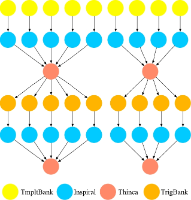
LIGO
Generates and analyzes gravitational waveforms from data collected during the coalescing of compact binary systems. Binary Inspiral workflows run through Pegasus on the LIGO Data Grid and the Open Science Grid.
Show runs ▾Hide runs ▴
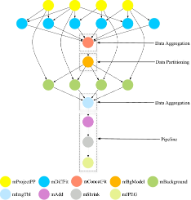
Montage
Created by NASA/IPAC, Montage stitches together multiple input images to create custom mosaics of the sky.
Show runs ▾Hide runs ▴
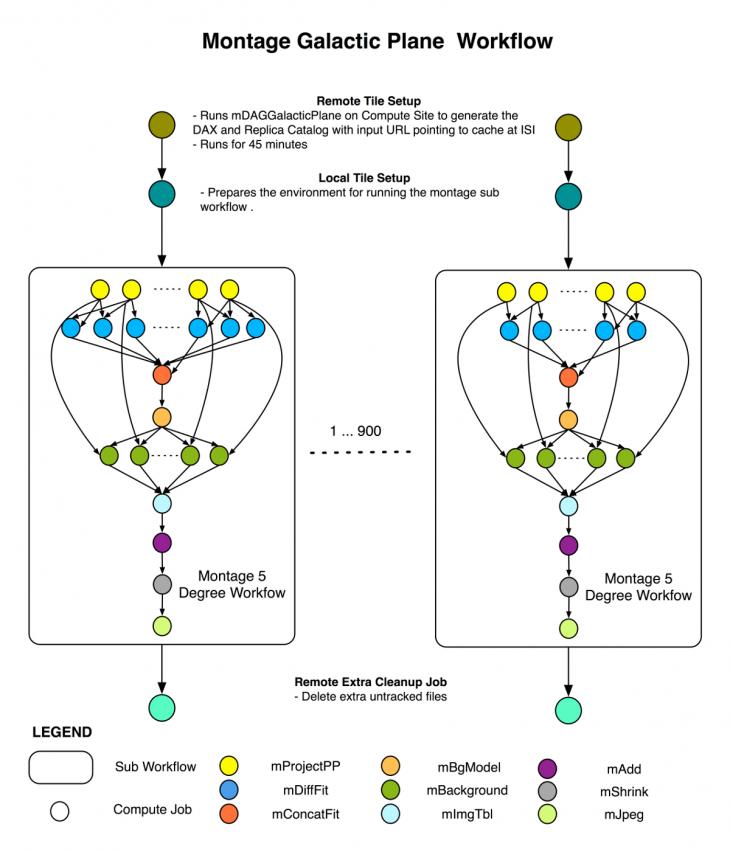
Galactic Plane
Uses the Montage image mosaic engine to transform the images of 17 sky surveys to a common pixel scale of 1 arcsecond, co-registered on the sky in Galactic coordinates and the Cartesian projection.
Show runs ▾Hide runs ▴
Run details coming soon.
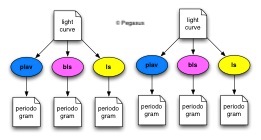
Periodogram
NASA’s Infrared Processing and Analysis Center (IPAC) computes periodograms from Kepler light curves, revealing periodic signals from transiting planets and stellar variability.
Show runs ▾Hide runs ▴
Run details coming soon.
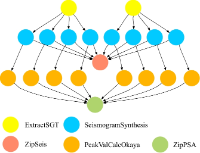
CyberShake
Used by the Southern California Earthquake Center to characterize earthquake hazards in a region. These workflows are from the 2011 production runs, which include high-frequency codes.
Show runs ▾Hide runs ▴
Synthetic CyberShake
A synthetic workflow corresponding to a full CyberShake site from the 2009 production run. All jobs run locally.
Show runs ▾Hide runs ▴
Run details coming soon.
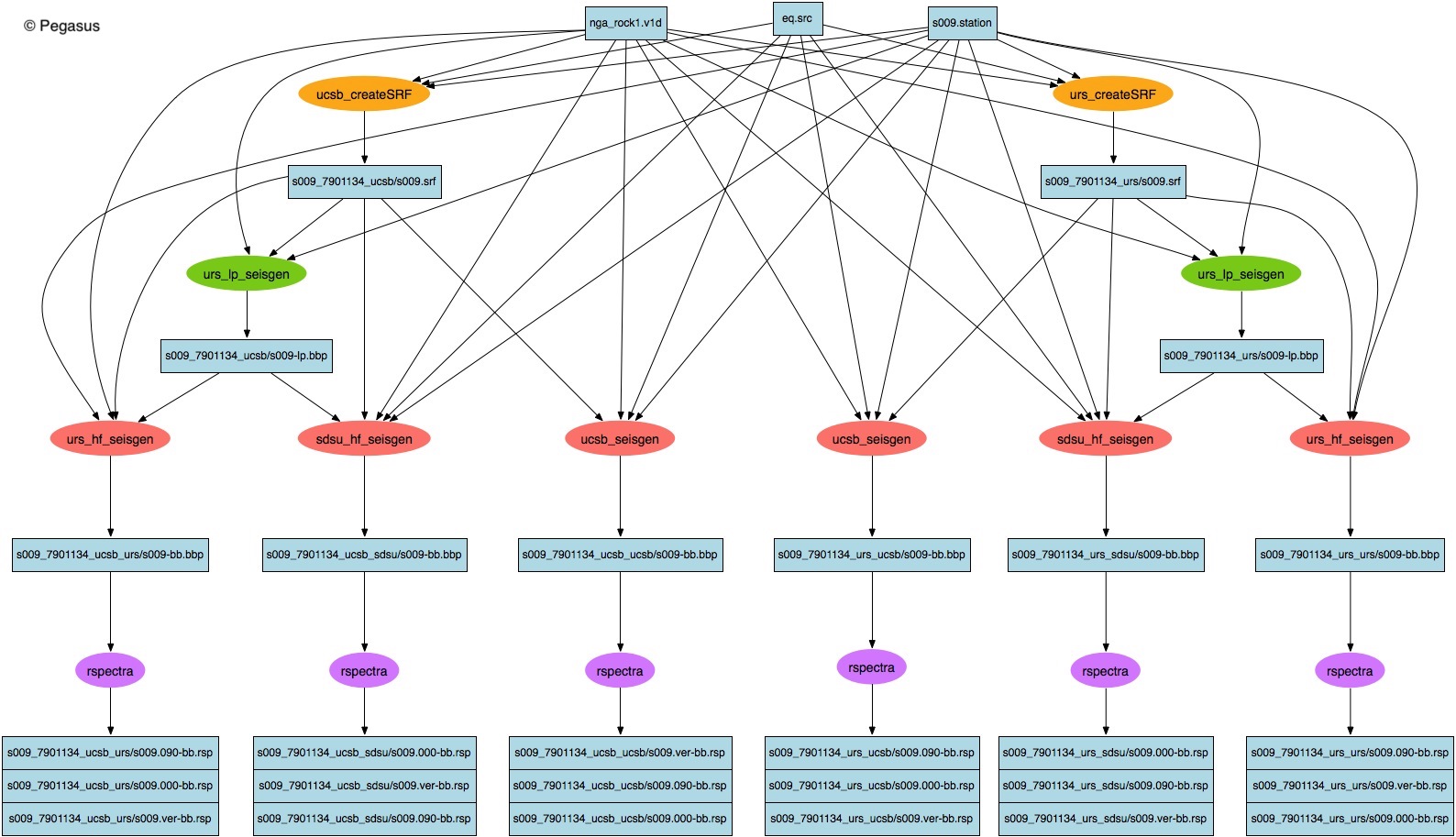
Broadband
Lets researchers combine long-period (<1.0 Hz) deterministic seismograms with high-frequency (~10 Hz) stochastic seismograms.
Show runs ▾Hide runs ▴
Run details coming soon.
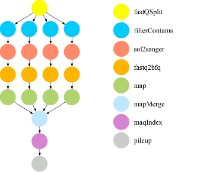
Epigenomics
Created by the USC Epigenome Center and the Pegasus team to automate various operations in genome sequence processing.
Show runs ▾Hide runs ▴
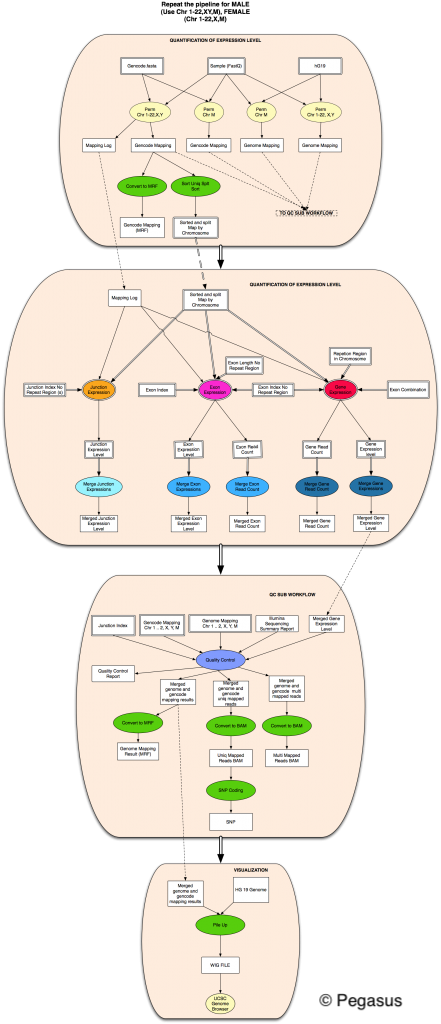
Brain (RseqFlow)
An RNA-Seq analysis workflow: quality control of sequencing data, signal tracks of mapped reads, expression levels, and differentially expressed genes.
Show runs ▾Hide runs ▴
Run details coming soon.

SIPHT
From the bioinformatics project at Harvard, SIPHT automates the search for untranslated RNAs (sRNAs) for bacterial replicons in the NCBI database.
Show runs ▾Hide runs ▴
Run details coming soon.
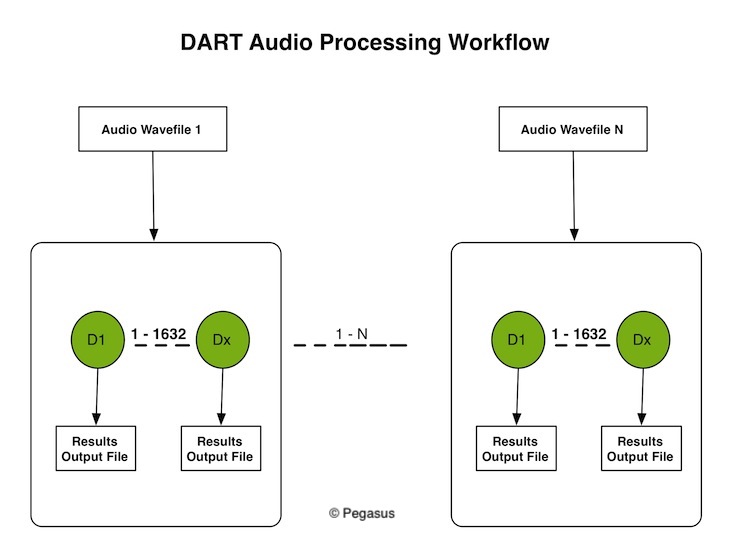
DART
Uses the DART Music Information Retrieval (MIR) platform to run a parameter sweep that finds the best settings for a sub-harmonic summation pitch detection algorithm.
Show runs ▾Hide runs ▴
Run details coming soon.