Applications increasingly operate across distributed environments that include sensors, edge devices, cloud platforms, and high-performance computing systems. Coordinating work across this computing continuum is difficult, particularly when network conditions change, resources become unavailable, or systems must respond rapidly to local events.
The DOE-funded SWARM project is developing decentralized methods that allow autonomous software agents to coordinate without depending on a central scheduler.
A recent paper, Decentralized Coordination of Autonomous Agents in the Compute Continuum Using Consensus, demonstrates how a consensus algorithm developed through SWARM can support dynamic, distributed decision-making.
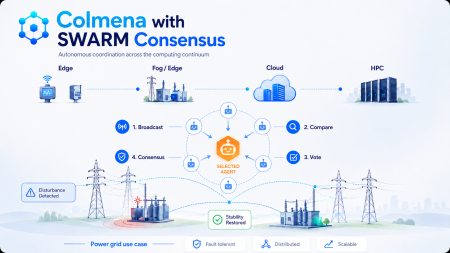
From Job Selection to Autonomous Roles
The original SWARM consensus algorithm was designed to help multiple agents agree on which agent should execute a computational job. Each agent evaluates its available resources, exchanges information with the others, and participates in selecting the most suitable agent.
The algorithm builds on concepts from Practical Byzantine Fault Tolerance while incorporating a cost model based on factors such as CPU, memory, and storage availability. This allows agents to make a shared scheduling decision while avoiding duplicate execution and eliminating the need for a central scheduler.
In the new work, the algorithm was extended beyond job selection. Agents now use consensus to decide which system capability, or role, should be activated and which agent should perform it.
A role may involve monitoring a sensor stream, analyzing an anomaly, optimizing a physical system, or initiating a corrective response. Unlike a workflow job, which is usually predefined, a role may need to be activated dynamically in response to changing conditions.
The consensus mechanism was integrated with COLMENA, a framework for developing autonomous services. When agents detect that a quality-of-service condition has crossed a threshold, they can initiate consensus, evaluate candidate agents, and elect the agent best positioned to perform the required role.
The selected agent activates the role, while the remaining agents record the decision and continue monitoring the system.
Demonstration on a Distributed Power Grid
The researchers evaluated the approach using a simulated electric power grid distributed across six FABRIC testbed sites.
Agents represented different regions of the grid and monitored local frequency conditions. When a generator or load was disconnected, the agents detected the disturbance and used the SWARM-derived consensus mechanism to elect a local leader.
The selected leader then activated a distributed model predictive control service that coordinated corrective actions with neighboring regions.
In experiments using as many as 60 nodes, the agents detected disturbances, organized themselves, selected leaders, and initiated corrective actions. Detection and coordination took less than ten seconds, while the grid returned to a stable state in approximately 27 to 40 seconds, depending on the disturbance.
The consensus process also introduced relatively little CPU and memory overhead.
Why This Matters
This work shows how an algorithm originally created for decentralized workload scheduling can become a broader coordination mechanism for autonomous systems.
The key question is no longer only: Which agent should execute this job?
It becomes: What action is needed now, and which agent is best positioned to perform it?
That capability is important for applications operating across the edge-to-cloud continuum, where systems may need to react to unexpected events without waiting for instructions from a centralized service.
Potential applications include autonomous scientific instruments, distributed robotics, emergency-response systems, edge-based artificial intelligence, and adaptive scientific workflows.
For example, an instrument could detect an unusual observation and use consensus to select a nearby agent to perform rapid analysis. A robotics team could reassign responsibilities when a robot or network connection fails. A scientific workflow could activate additional analysis or data-movement services when runtime conditions change.
Building Resilient, Self-Organizing Cyber-Physical Systems
As cyber and cyber-physical systems grow in scale, complexity, and geographic distribution, resilient decentralized control is becoming essential. The SWARM consensus approach provides a foundation for autonomous agents to coordinate decisions, adapt to changing conditions, and continue operating despite failures or disruptions. This capability will be increasingly important for large-scale scientific, energy, and robotic systems operating across the computing continuum.
The research described here appears in “Decentralized Coordination of Autonomous Agents in the Compute Continuum Using Consensus,” published in Frontiers in Complex Systems in April 2026. This work was conducted as part of the Juan de la Cierva (JDC2023-051290-I) grant and the DISCOVER-US 1-month exchange grant. The DISCOVER-US project has received funding from the European Union’s Horizon Europe research and innovation funding programme under grant agreement number 101135064. The following projects have partially supported by this work: CEX2021-001148-S and PID2023- 147979NB-C21 from the MCIN/AEI and MICIU/AEI/10.13039/ 501100011033 and by FEDER, UE, and by the Departament de Recerca i Universitats de la Generalitat de Catalunya, research group MPiEDist (2021 SGR 00412). Part of this work was made possible through funding from the US DOE under grant #DE-SC0024387.